
What Seven Years of Climber Data Tell Us About Where Indoor Climbing Is Headed
In 2019, the Climbing Wall Association set out to better understand who indoor climbers were, how they used gyms, and what they valued most. At the time, the industry was still riding a long wave of growth and professionalization. Seven years later, the landscape looks noticeably different.
The 2026 Indoor Climber Survey, completed by more than 5,000 climbers across the U.S. and Canada, gives us a rare chance to look not just at where climbers are today, but how behaviors, expectations, and priorities have shifted since 2019. For gym operators, these changes aren’t abstract. They show up daily in staffing challenges, decisions on the use of space, programming choices, and member retention questions.
Here’s a look at the most relevant trends that emerge when we compare the 2019 and 2026 report side by side, and why they matter for the future of commercial climbing gyms.
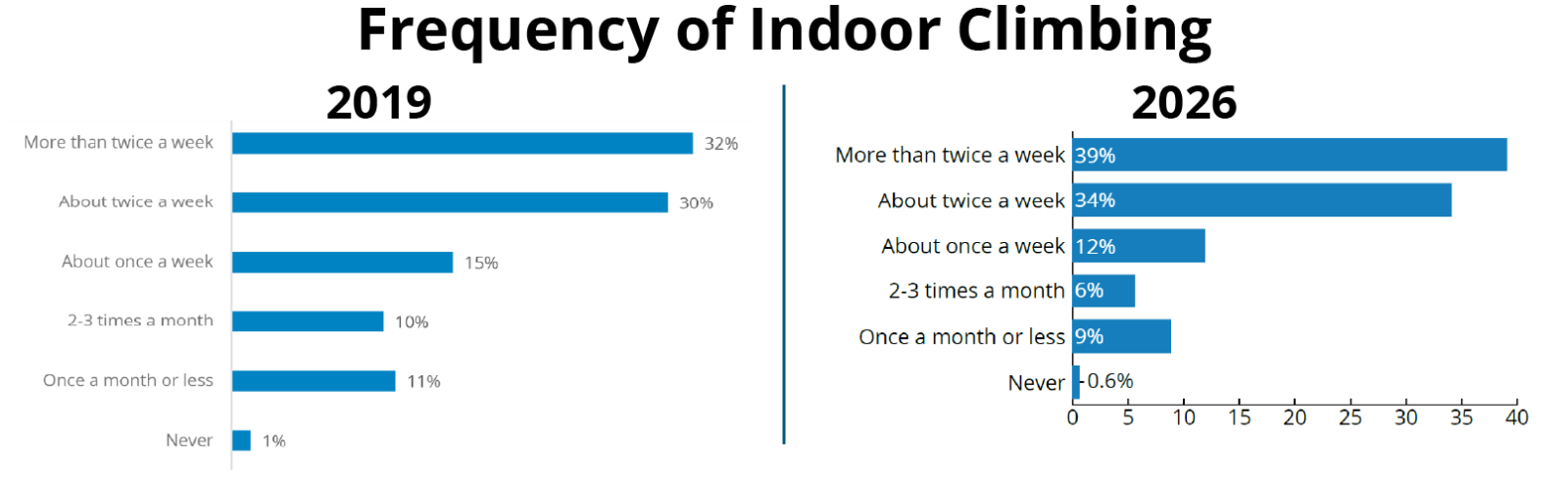
In both 2019 and 2026, roughly half of all respondents had been climbing indoors for two years or less. That headline hasn’t changed. What has changed is how frequently those newer climbers are showing up.
In 2019, about 60% of climbers reported climbing twice a week or more. By 2026, that number had climbed to nearly three-quarters. In other words, today’s climbers may still be relatively new, but they are integrating climbing more deeply into their weekly routines.
“This reinforces something gym operators have been seeing anecdotally for years,” says Garnet Moore, Executive Director of the CWA. “Climbing isn’t just a side activity. For a growing share of participants, it’s their primary form of exercise, and their primary community.”
High-frequency participation places different pressures on walls, padding, holds, and staff. Maintenance planning, route turnover cadence, and member experience consistency matter more than ever when climbers are coming in two, three, or four times per week.
The 2019 survey was dominated by climbers aged 25–34. While that group remains substantial, the 2026 data shows a clear broadening of the age distribution, with stronger representation among climbers aged 35–54, and a modest increase among climbers over 55.
At the same time, household incomes have shifted upward. In 2019, the majority of respondents fell between $50,000 and $150,000. In 2026, a significant share reported household incomes above $150,000, with meaningful representation above $200,000.
This doesn’t necessarily mean that climbing has become exclusive, but it does suggest that many gyms are now serving a population that is more financially stable, more time-constrained, and more deliberate about how they spend their discretionary hours.
Value propositions resonate differently with this audience. Cleanliness, crowd management, predictable experiences, and flexible membership options frequently matter more than novelty amenities.
Industry conversations sometimes frame bouldering as “taking over” gyms. The data tells a more nuanced story.
In both 2019 and 2026:
- Roughly two-thirds of climbers reported doing both routes and bouldering
- The remaining third split fairly evenly between “just routes” and “just bouldering”
- Among those who do both, time spent is now evenly split 50/50
This is a subtle but important shift from 2019, when route climbing still held a slight edge in ho climbers spent their time.
“What we’re seeing isn’t an all or nothing scenario,” Moore notes. “Successful gyms manage balance well and have other aspects that unite their community beyond climbing styles. Gyms can strike a balance between disciplines, between beginner and advanced terrain, and between social and training-focused members while still having a unifying vision.”
Over-focusing on one discipline at the expense of another could risk alienating a large portion of committed users. Flexibility in terrain design and long-term capital planning remains critical.
Download The Report Here
Training has long been part of climbing culture, but it has become more focused and mainstream in the past few years. In 2019, just over half of respondents reported training for climbing. By 2026, that number had grown to over 60%.
That said, the data also shows limits:
- Free weights, pull-up bars, and hangboards remain the most-used tools
- Specialty features like Treadwalls, training boards, and spray walls see uneven use, often because climbers report they’re unavailable, unnecessary, or poorly integrated
Importantly, the elements that climbers say they would “get rid of” in 2026 include underused training boards and fitness equipment that displace climbing terrain.
Training resources don’t need to be expansive, but they do need to be intentional. High-use, low-friction infrastructure outperforms niche equipment that lacks programming or education. Coaching, training communities, and more programming could be increasingly valuable in the future.
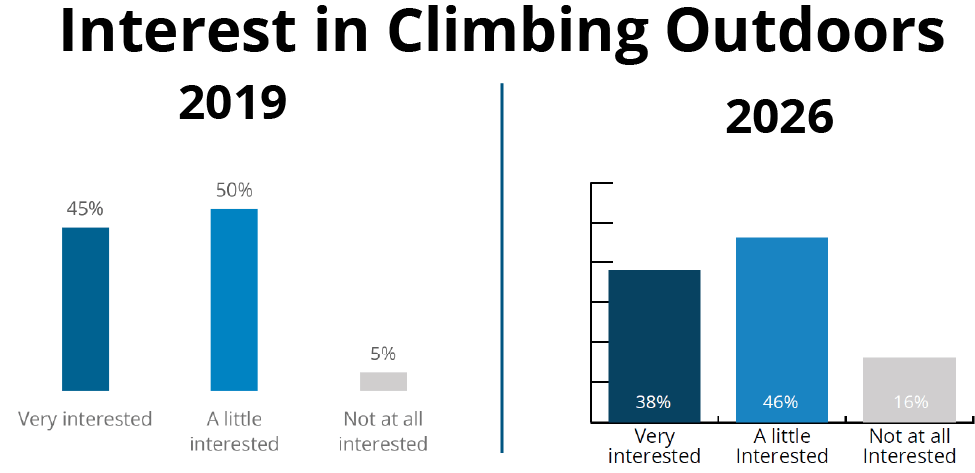
One of the most striking differences between 2019 and 2026 shows up in attitudes toward outdoor climbing.
In 2019, most indoor-only climbers expressed clear interest in transitioning outdoors, with over half saying they intended to start within a year. In 2026, that has changed:
- Nearly one-third of climbers do not climb outdoors at all
- Among indoor-only climbers, interest in starting outdoors is lower
- Fewer climbers say they would take an indoor-to-outdoor transition class, even if their gym offered one
This doesn’t reflect disengagement. Instead, it suggests that for many participants, the gym IS the end goal. Many operators have felt this trend, but it is unclear what is driving this trend. The largest barriers towards climbers heading outdoors were reported to be a lack of equipment, a lack of knowledge on how to climb outdoors, and a lack of partners. Only one in five respondents reported that they just weren’t interested in outdoor climbing.
“We should be careful not to assume that ‘indoor-only’ means ‘less committed,’” Moore says. “For many climbers, gyms offer exactly what they’re looking for: community, challenge, consistency, and the sport they love, all in one place.”
Gyms can, and should, stand on their own value. Outdoor transition programming can still serve a role, but it’s no longer a universal expectation or growth driver. Climbers do still seem to be drawn to the outdoor aspect of climbing though, with 74% of respondents saying that they were a little to very interested in climbing outdoors in the future.
2026 Most Desired Membership Features
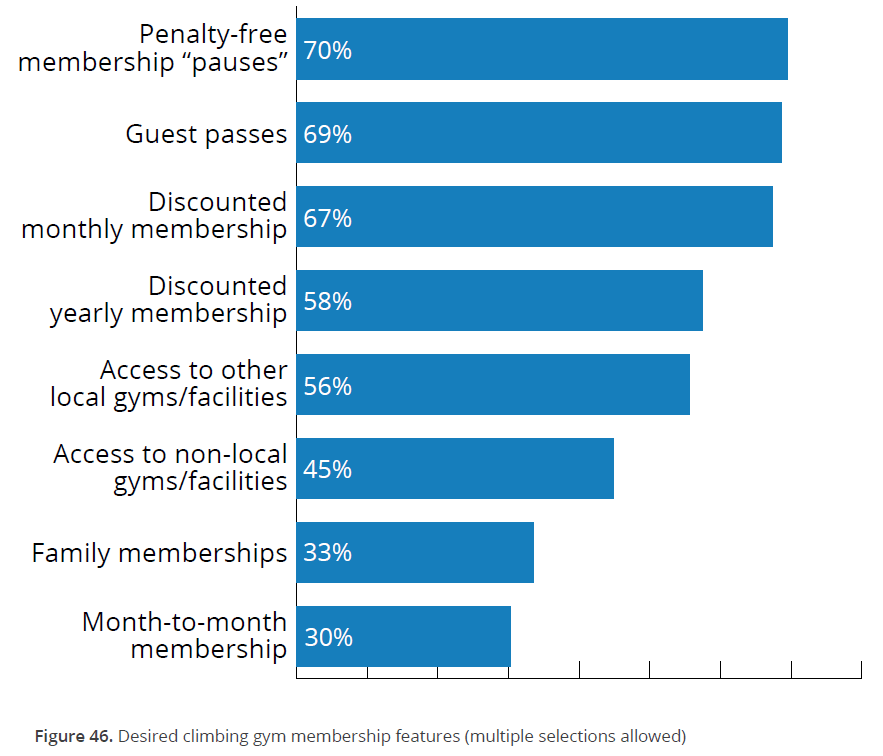
Few results are as consistent, and as relevant, as the responses around membership fees.
In both surveys, penalty-free membership pauses ranked near the top. By 2026, they clearly emerged as the single most desired feature, followed closely by guest passes and discounted monthly memberships.
At the same time:
- Month-to-month memberships remain relatively unpopular
- Family memberships are valued primarily by climbers with kids, not the broader base
This reflects broader economic uncertainty and changing work patterns since 2020, but it also signals something more structural: climbers want choice without penalty.
Rigid membership structures are increasingly out of step with user expectations. Flexibility, transparency, and clarity often matter more than sheer price.
When asked what they would get rid of at their current gym, climbers in both surveys consistently cited:
- Kid-related issues (unsupervised kids, parties, team overcrowding)
- Membership costs and fees
- Peak-time crowding
What’s notable in 2026 is the lower percentage of climbers who say “nothing,” suggesting that as gyms mature, expectations rise.
Many of these challenges are symptoms of success. Addressing them often comes down to scheduling, communication, and space management, not necessarily requiring wholesale reinvention.
Taken together, the 2019 and 2026 Indoor Climber Surveys tell a clear story about how the climbing wall industry has matured. The average climber is slightly older, slightly more affluent, climbs more often, and is increasingly comfortable treating the gym as their primary, or sole, climbing environment.
For operators, the takeaway isn’t about chasing trends. It’s about getting clarity: understanding who your climbers are, what they value today, and where flexibility and focus will matter most tomorrow, and the CWA can help with that.
“Data doesn’t tell gyms what to do,” Moore reflects. “But it does help us ask better questions, and make more confident decisions in an increasingly complex world.”
The full 2026 Indoor Climber Survey Report is available to CWA members at a discount and supporting gyms for free, we encourage operators to dig into the details, compare them with their own experiences, and share insights with the broader community. The industry continues to evolve so understanding our climbers and collaborating together is one of the best tools we have to anticipate future trends.
Interested in More?
The CWA is excited to release the results of that survey in a full report to our members, for the low price of $200, a $600 discount from the full $800 price. And, of course, the gyms that signed up to help support and distribute this survey will get the full report for free.
Contributed to the report? You will receive the report for free via email. Contact the CWA if you haven't!