
Return on Investment in Certifying Staff
A chief issue in the operations of a climbing facility is often money, or more accurately, financial sustainability. Despite what the public may think in terms of how expensive memberships and day passes are, there are some substantial expenses to cover, not the least of which includes the salaries, staff training, and the ongoing rate of turnover. Of course, you likely know this better than anyone.
Article At A Glance |
|
With the current economic temperature, this is truer than ever. This can lead a facility to question the return on investment in providing staff training and professional development.
Running a university climbing wall, I had staff turnover seasonally, and few intended to stay on beyond the year of their graduation. As a part of a larger facility, there was no revenue from memberships or day passes. The only source of revenue was programming. The funds that came in from the programs we offered were all the funds available to support salaries, maintenance, and any equipment purchases. If I wanted new holds or flooring, I needed revenue to make that happen.
Learn More About CWA Certifications
Visit the Certification Dashboard
I was well trained, but often the staff applying for jobs had experience as climbers, but not as an instructor or a routesetter. Training for these roles can be time-consuming and require apprenticeship time to really hone the skills. Being the manager, coordinator, head routesetter, and head instructor meant I needed help.
The CWA’s Certification Program became the answer.
The CWA’s Certification Programs have three tiered offerings, all of which end in a Provider, allowing staff to be trained by staff, instead of by the CWA.
These three are:
- Climbing Wall Instructor (CWI) Certification
- Professional Routesetting (PRS) Certification
- Work at Height (WAH) Certification
The Provider certifies on behalf of the CWA and uses the CWA’s resources to conduct the administrative side of certification. This is a huge plus for someone in my shoes.
Being able to certify staff in-house gave me the following advantages:
- Improved risk management in daily operations by having knowledgeable and trained staff
- Affordability and reduced costs to certify staff
- Created revenue by opening certification opportunities for others
- Determining when and to whom to offer the certification
- Preparation time for staff to ensure their success
- Risk Management
Although I could train staff to monitor the activities of climbers during their shifts, once they became certified, they held that responsibility with a much higher regard. The certification gave staff a greater depth of understanding about the intention behind operational practices in reducing risk of harm. In turn, being informed put more responsibility on the staff to navigate incidents which could result in injury, or which had resulted in injuries.
Affordability
The initial investment to go to the CWA Summit and go through the Certification was an investment that indirectly paid off in staff retention and program quality. I used the opportunity for certification as a carrot to build retention in my staff group by giving certified staff better shift selection, priority for vacation requests, and better pay.
Successful CWA CWIs develop skills for creating effective learning outcomes, designing learning activities, and risk mitigation strategies. These skills can then be leveraged to design and implement additional programs.
The beauty in offering more programs is illustrated in the diagram below:
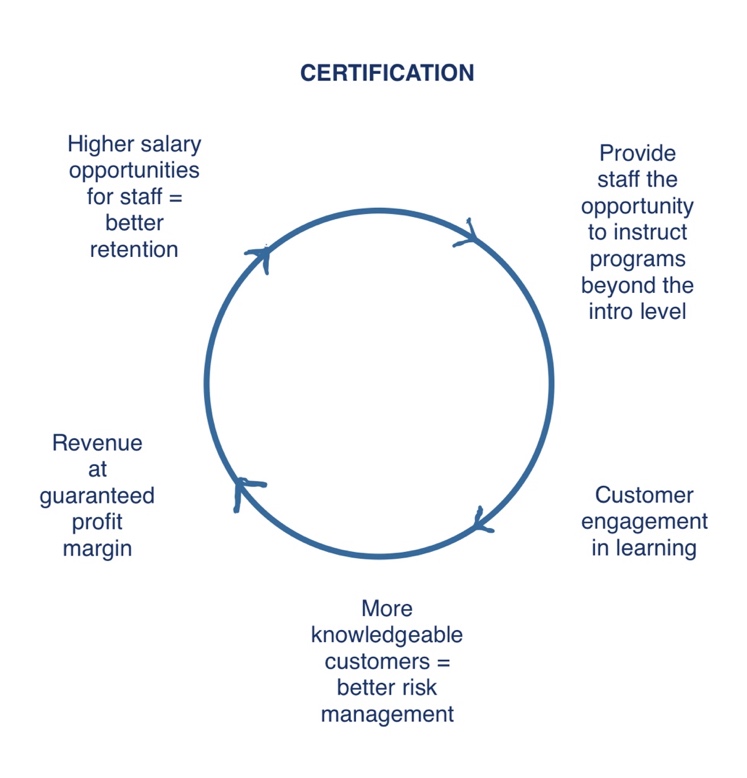
When I offered a CWI Certification or training for routesetting, I always opened registration spots for folks outside the staff group and charged a registration fee. There were always folks who worked in other gyms or were interested in working in a gym who were interested in becoming certified.
The revenue from these registrations helped offset the costs associated with certification and the additional time I had to put in to do the assessments.
Successful Certification Candidates
By knowing the program and the abilities of the staff looking to become certified, it was very easy to create opportunities for prospective certification candidates to practice and prepare for the certification assessment. This meant my investment of time and money was spent with the knowledge of getting the result I wanted.
Well-known and celebrated Tommy Caldwell has been quoted as saying, “Stand at the base and look up 3,000 feet of blankness. It just looks like there is no way you can climb it. That’s what you seek as a climber. You want to find something that looks absurd and figure out how to do it.”
I think most folks who find themselves working in climbing gyms feel this same desire to challenge themselves, reach the next level, whether that is a climbing grade or a greater level of understanding. Sharing with others what one is passionate about can create an incredibly fulfilling job. By giving certifications to your staff, the opportunity to challenge their understanding and get certified can drive greater interest in sticking around to work in the industry.
About The Author
 Heather Reynolds is a licensed kinesiologist, High Five Trainer (Sport, PCHD), CEC Climbing Coach, CWA Climbing Wall Instructor Certification Provider Trainer. She works as a Consultant to the CWA. She blends her knowledge of movement, physiology, and education to develop a multitude of successful climbing programs designed to support and engage youth. Having worked with youth for over 30 years as a recreation instructor, leader and educator, Heather supports the values and expertise available in the High Five Program, bringing quality assurance to youth-based sport and recreation programming.