
What Makes a Climbing Gym a Third Place
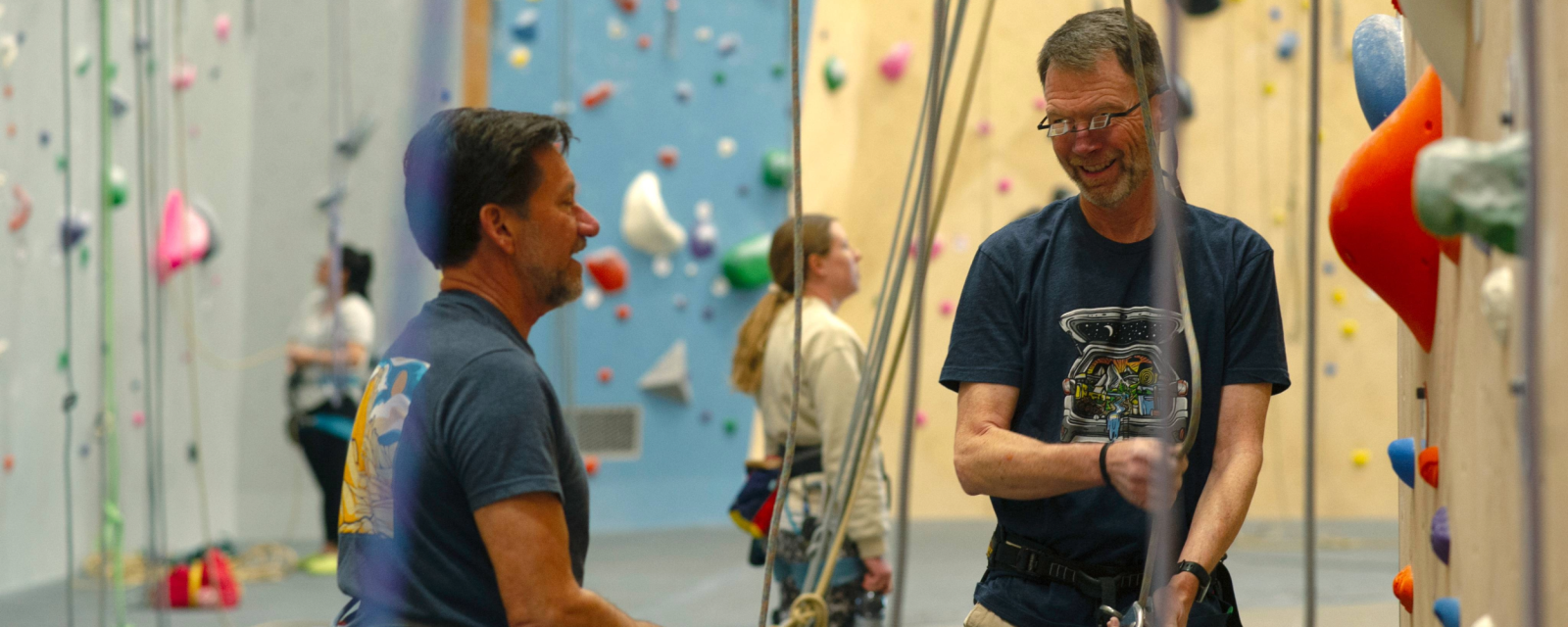
Ray Oldenburg coined the term “third place” to describe the social environments that exist that are not the home (the first place) or work (the second place). Third places serve as hubs where people gather for conversation, recreation, and connection.
Cafés, bars, churches, barbershops, parks, and community centers have commonly filled this role. If you can be considered a “Regular”, it is likely a third place. I sometimes joke that if a 90’s sitcom could be based on it, it may be a third place.
What distinguishes the third place from other social environments is not simply that people gather within them, but that these spaces cultivate a sense of belonging, spontaneity, and shared identity. They are the settings where communities form and where individuals find social nourishment that neither domestic life nor professional life consistently provides.
Article At A Glance |
|
For more about a similar idea, please see my recent CWA article about reducing the opportunity cost of working in climbing and the influence of Self Determination Theory on this aspect of the climbing wall industry.
At the core, third places rest on the idea that human connection is essential to well-being. Oldenburg argued that social life can decay when communities lack informal gathering spaces—places where people can step outside the pressures of productivity and engage with one another.
Over time, research has supported this idea, suggesting that regular participation in community spaces strengthens social bonds, increases resilience, and improves mental health. Third places act as social glue, enabling relationships that bridge demographics, beliefs, and backgrounds. However, this is not to say that you might not be intimidated by what others might call their third place. Some spaces are more comfortable for people from specific backgrounds or identities.
READ ALSO: CWA Community Building Series
I would argue that indoor climbing gyms have solidly emerged as effective third places. As modern work life becomes increasingly digitized and sedentary, physical activity has become not only a necessity outside of the work/home binary but also a vehicle for social connection. When people share in struggle—whether it’s a hard training session, a long run, or a repeated attempt on a difficult boulder—they experience connection rooted in mutual challenge and mutual support.
Interestingly, some aspects of these spaces can take place online or remotely and still provide valuable, movement-based connection (think: the Kilter App or 8a.nu). Unlike many social settings, exercise communities offer structured opportunities to interact; spotting a climber, cheering for someone’s send, teaching a technique, or laughing about a fall all allow this sort of human interaction.
Climbing uniquely intersects the philosophy of connection and the philosophy of movement; the problem-solving and physical difficulty all coalesce in an interesting way to connect.
Climbers must trust others to belay or spot them, they must communicate clearly, and they must acknowledge limits and fears to themselves also. It is also a sport where success is publicly visible: everyone in the climbing gym can see you triumph, and everyone can see you flail—though perhaps a topic for a future article is the idea of how we tend to compare others’ successes or best days against our own failures or bad days.
Because of these dynamics, climbing gyms have quickly become some of the strongest modern examples of third places. They are not just workout facilities—they are the context in which a community exists.
At the most basic level, indoor climbing gyms mirror characteristics of third places:
- Neutral Ground: Anyone can show up, regardless of identity, profession, or background. Once inside, every climber is simply another climber, not a job title or résumé.
- Leveling Effect: Climbing naturally flattens certain hierarchies. Performance varies by style, height, experience, body type, and creativity. You might send a boulder that a stronger friend struggles with, and vice versa. This fluidity disrupts status and creates mutual respect. However, as we all know, other social identities may be highlighted or valued differently (or even tokenized) in the climbing community. It isn’t just that the climbing gym removes these identities and whitewashes the participants.
- Conversation as the Secondary Activity: Even though climbing is physical, rest time between attempts is where relationships actually form. Conversations flow easily because the environment offers endless prompts: beta, gear, new routes, fear, progress, failure, and stoke.
- Accessibility and Regularity: An indoor climbing gym’s value as a third place strengthens when members return consistently. Seeing familiar faces daily or weekly builds comfort, familiarity, and casual friendship.
- The Feeling of a Home Away from Home: Many climbers feel more themselves in a climbing gym than anywhere else. It becomes a refuge from work stress, life stress, and digital noise. The sense of shared ritual—warming up, projecting, cooling down—creates its own culture.
Yet climbing gyms also offer something traditional third places do not: structured physical challenge. That challenge accelerates relationship-building by combining physical exertion with emotional expression. When someone cheers for you when you send, they are investing in both your physical success and you.
Climbing gyms blur the line between personal growth and social participation, merging the solitary pursuit of improvement with the human need for connection.
Moreover, climbing gyms serve as creative third places. Routesetting is a form of artistic expression that produces shared experiences rather than static objects. It is the choreography, not just the dance. Climbers interact with the routesetter’s ideas, intentions, and movement patterns, forming indirect connections with someone they may never speak to. This creates layers of community: climber-to-climber, climber-to-routesetter, member-to-staff, and individual-to-environment.
As indoor climbing gyms grow in popularity, they increasingly operate as “movement communities” rather than mere fitness centers. However, as owners expand their locations to become chains, does having more facility options make it harder to participate in a community where everyone is semi-nomadic in their climbing lives?
Many people join not because they want to get stronger, but because they want a place where they feel known. This reflects a broader cultural trend: as traditional community institutions decline, people seek alternative spaces that provide the same emotional nutrients. Indoor climbing gyms step into that gap.
However, being a third place comes with responsibilities.
Gyms must balance accessibility with safety, community with professionalism, and stoke with sustainability. The atmosphere that members experience as “effortless community” is actually the product of thoughtful design: welcoming staff, intentional route turnover, clear communication, consistent programming, and inclusive culture-building. None of these things happens by accident. They require care, labor, and emotional investment.
Where does a gym differ from the traditional ideals of a third place?
- It’s neutral ground: to paraphrase Animal Farm, In the gym, all climbers are created equal. But some are more equal than others.
- It’s unstructured: Some gyms have very rigid (safety, cultural, social) systems and rules that can hinder certain aspects of creativity.
- It’s not expensive: I don’t think I need to elaborate on this one—gyms are often prohibitively expensive to many would-be climbers.
- It’s a place to talk: In the gym, sometimes when it is less busy and more headphones than ear canals, you may not have as much conversation as you might in other third places.
- It’s near your home or work: Not always the case!
- It has regulars: Yes and no. Often, there are regulars, but sometimes, if the community is huge and has many gyms and people have inconsistent climbing schedules, it can be hard to see the same people again and again.
That brings us to a deeper layer of third-place philosophy: third places serve their communities best when they are not burdened with second-place pressures: climbing shouldn’t feel like work.
Home and work come with expectations, obligations, and stress. Third places function as social sanctuaries precisely because they do not replicate those pressures. People benefit from climbing gyms because the environment feels playful, free, exploratory, and encouraging rather than transactional or compulsory.
This is partly one of the challenges to working in an indoor climbing gym as a dedicated and lifelong climber: you might feel like you never quite get to escape the work vibes.
But this dynamic raises an important question: what happens when the people who create and maintain a third place are working within their community’s sanctuary?
Climbing gym employees—coaches, routesetters, desk staff, instructors—often enter the field because the climbing gym is already their third place. They love climbing, love the culture, and want to contribute to a space that shaped their identity.
The philosophical paradox is that when someone’s third place becomes their workplace, the space can no longer function as a third place for them in the same way. The climbing gym remains familiar but becomes less restful, more demanding, and more emotionally complex. The boundary between personal joy and professional obligation becomes thin, sometimes invisible.
For members, the climbing gym is an escape. For staff, the gym can be physically demanding, emotionally laborious, and socially draining. Staff mediate conflict, soothe frustrations, protect safety, run events, teach skills, and maintain enthusiasm. They are the guardians of the third place, which can leave them with little of its benefits.
This tension does not diminish the value of climbing gyms as third places. Instead, it highlights the importance of supporting the people who make that sense of community possible.
Third places flourish when they remain playful and restorative for everyone who participates in them—including those who stand behind the desk, on the ladders, or on the coaching mats.
About the Author
 Carter Smith is a coach, routesetter, and outdoor educator. He is currently the Head Coach for Triangle Rock Club and lives in North Carolina with his partner and 2 dogs. Carter received his Masters in Experiential and Outdoor Education from Western Carolina University in 2022. Carter’s passion lies in helping children and adults to use climbing as a vehicle for self discovery.