
The Importance of Written Work at Height Plans
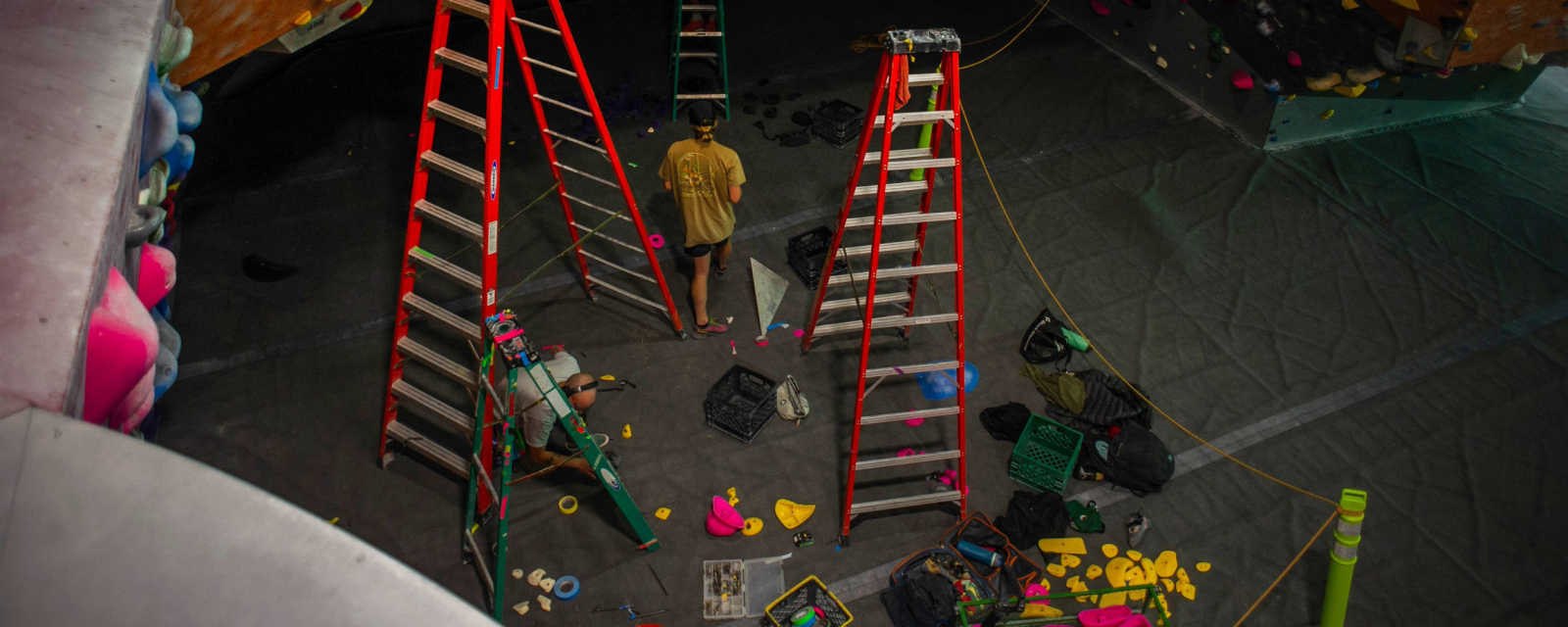
Does your gym have a written Work at Height plan?
Who wrote it?
When I first started working in the climbing industry, I was told that the Occupational Safety and Hazard Association (OSHA) “wasn’t in indoor climbing gyms.” I’ve heard that “they aren’t really watching.”
Lately, as I travel, I hear a lot of routesetters articulate that our work would be impossible if OSHA stepped in. The whole industry would shut down.
None of that is true, of course. Health and safety regulations apply to all working environments, climbing gyms included. OSHA inspectors have already visited indoor climbing gyms across the country, usually after incidents of workers getting hurt. And while many climbing gyms are using systems that would make a health and safety inspector shudder, many others have already adopted OSHA-compliant systems.
It is important to note that different industries have slightly different standards. Practices that work for construction don’t necessarily work for a maritime environment. OSHA relies heavily on industry experts and trade organizations to inform its policies, and this is where the Climbing Wall Association's Work at Height (WAH) Standard and Certification Program steps in.
Writing the Work at Height Standard is one thing, but applying it to any individual climbing gym is another. The CWA Committees develop broad standards so that they can be applied across a wide spectrum of facilities. This leaves gym operators potentially wondering how to apply the standards to meet their unique needs. So what do you do?
Certification Summit (WAH Available) in FL -
Online Course Opens January 12
Enter the CWA Certification Program! Work at Height (WAH) Certifications provide workers with the training and skills they need to do their job compliantly, and each level aligns closely with the OSHA designations of Authorized, Competent, and Qualified persons.
- Authorized persons are approved and trained by the employer to perform a specific task.
- Competent persons are expected to be capable of identifying and controlling hazardous working conditions.
- Qualified persons are workers who, “by possession of a recognized degree, certificate, or professional standing, or who by extensive knowledge, training, and experience, have successfully demonstrated their ability to solve or resolve problems relating to the subject matter, the work, or the project.” (OSHA 1926.32(m)).
Interpreting the CWA WAH Standard and applying it to any given workplace should be done by a Qualified Person.
So, how does someone become a “qualified person?” Perhaps more importantly, how does that person demonstrate that they are a “qualified person?” The answer lies in the first clause of the OSHA definition: possession of a recognized degree or certificate.
Let’s look at each of the CWA
Work at Height Certifications:
WAH Level 1 teaches workers the fundamentals of performing tasks at height.
From ladder best practices to fall protection systems when working on ropes, WAH Level 1 technicians learn how to mitigate risk to themselves and others while working efficiently, as well as some basic rescues. This certification aligns with the role of an “authorized person.”
WAH Level 2 should be considered for anyone in a supervisory role in a climbing gym, and mirrors the OSHA designation of “competent person.”
Moving beyond foundational techniques, WAH 2 teaches technicians to recognize misuse, a critical skill when managing a team conducting Work at Height operations, WAH Level 2 technicians learn more about the why behind different gear and systems choices, as well as best practices for working behind the wall. That’s right, operations behind the wall often carry their own standards and best practices, and any staff conducting work at height in those spaces should be trained! The WAH Level 2 course also includes more complex rescue scenarios, a skill that every routesetting team should drill regularly.
WAH Level 3 is perfect for anyone responsible for policy design and implementation in a climbing gym, or a “qualified person.”
Technicians learn how to choose equipment and systems, find and apply relevant health and safety regulations, and create documentation like Job Hazard Analysis forms and Work at Height plans. WAH Level 3 Technicians are also able to become Providers, authorized to provide WAH Level 1 Certifications.
Maybe you’re thinking, “We’re a bouldering-only facility, we don’t need our employees to be WAH certified.” You wouldn’t be alone. It’s easy to associate the CWA WAH Certification Program with work on ropes, since we train technicians to use a two-rope system with separate suspension and fall arrest lines.
However, any work conducted more than four feet off the ground is considered Work and Height, and unless your boulder walls are eight feet tall, the CWA WAH Standard is going to be applicable in your facility.
We all know that ladders are a mainstay of bouldering gym operations, and your team should be trained in industry-specific best practices for using ladders for routesetting. CWA WAH Certification Courses teach technicians to think critically about the risks in their work environment, regardless of whether they are working on rope systems or a ladder.
If you are operating a climbing gym, you have employees who are working at height. If you have employees working at height, you need to have a written Work at Height plan, created and implemented by a qualified person. The CWA Work at Height Certification Program provides a path to become that qualified person.
So back to those first questions: Does your gym have a written Work at Height plan? Who wrote it?
Maybe it’s time to get your team certified.
Learn More About Work at Height
As a thought leader for the indoor climbing industry, the CWA protects and connects the entire industry through professionalization. Our certifications help offer you a leg up, and your facility needed legitimacy.
About Foxman McCarthy-James
 Foxman McCarthy-James is a freelance routesetter with over a decade of commercial and competition-setting experience. She has brought her background in education into her routesetting career, serving as the Routesetting Education Consultant for the Climbing Wall Association and contributing routesetting educational content for the Climbing Business Journal. She is passionate about continuing the conversation on how we can make our industry more welcoming and inclusive.